How We Build Your Program When You Have Pain
One of the biggest misconceptions about rehab coaching is that it’s just “normal training, but easier.”
People often imagine that if someone has pain, the solution must be to tone everything down: remove the difficult lifts, substitute lighter exercises, add some band work or stretching, and hope the problem settles down. But that’s not what effective rehab-based programming looks like.
When someone comes to us with pain, we are not simply modifying a template and hoping for the best. We’re not guessing, and we’re not trying to bubble-wrap you away from training. In fact, our goal is usually the opposite which is to help you return to meaningful training as quickly and safely as possible.
Doing that requires a different framework than most people are used to.
When we design a program for someone dealing with pain, we’re not just thinking about exercises. We’re thinking about systems. We’re analyzing how your body behaves under different types of stress, how your tissues respond to loading, how fatigue influences your movement patterns, and how life outside the gym interacts with your recovery capacity.
Your program isn’t built around a diagnosis alone.
It’s built around patterns. Patterns in how you move. Patterns in how your body tolerates load. Patterns in when and why symptoms appear. Patterns in how your life affects your ability to recover.
That’s because pain rarely has a single cause. Instead, it emerges from the interaction between many factors—mechanical stress, nervous system sensitivity, training history, and recovery capacity.
So today I want to walk you through how that process actually works. Not in a vague “trust the process” way. But in a this is literally the reasoning process behind how we build your training plan kind of way.
Step One: We Start With Movement, Not Muscles
The first thing we evaluate when someone comes to us with pain is how they move.
This might sound obvious, but it’s actually a major shift from the way many people approach injuries. A lot of traditional approaches begin by focusing on the painful structure. If your knee hurts, the knee becomes the center of attention. If your shoulder hurts, everything revolves around the shoulder. But the human body doesn’t function in isolated pieces.
Movements like squats, hinges, presses, and pulls involve coordinated activity across multiple joints and muscle groups. When something hurts, the body often adapts by redistributing load somewhere else. Sometimes that redistribution is helpful. Sometimes it creates new problems.
So instead of immediately prescribing exercises, we begin by observing movement patterns. We watch how you squat, hinge, press and pull, brace your trunk, rotate and transition between positions, and more.
We’re not just watching the movement itself but also how the movement changes under different conditions.
How does the movement look when the load is light?
What happens when the load increases?
What changes when fatigue accumulates?
These changes often reveal the strategies your body is using to protect itself.
For example, someone with knee discomfort may subtly shift their weight backward during a squat to reduce knee stress. Someone with shoulder irritation might avoid the deepest portion of a press or alter the path of the bar.
These adjustments aren’t mistakes. They’re adaptations your nervous system makes since it’s constantly trying to manage load in a way that feels safe.
Our role is to understand those strategies and determine:
Which ones are helping you tolerate load
Which ones might be contributing to symptoms
And which ones can be challenged gradually as tolerance improves
This is one of the reasons two people with what appears to be the same injury often receive completely different programs. Because their bodies are solving the problem in different ways.
Step Two: We Evaluate Load Tolerance
Once we understand how you move, the next step is determining how much load your body can currently tolerate. This is one of the most important concepts in modern rehabilitation.
Every tissue in the body from muscles, tendons, ligaments, cartilage, and bone has a certain capacity to tolerate mechanical stress. When the stress placed on that tissue remains within its capacity, the tissue adapts and becomes stronger. When stress consistently exceeds that capacity, irritation can occur.
Most gym-related pain isn’t caused by a single traumatic event. Instead, it’s often the result of a mismatch between load and capacity over time.
This mismatch can occur in several ways:
A sudden increase in training volume
A rapid jump in intensity
Changes in movement patterns
Accumulated fatigue
Or reduced recovery capacity due to life stress
To understand where that mismatch might exist, we look at several key factors.
Volume Tolerance
How many sets and repetitions can you perform before symptoms appear?
Sometimes people tolerate heavy loads well but flare with higher total volume. Others tolerate high volume but struggle when intensity approaches maximal effort.
Understanding this distinction helps determine how the training program should be structured.
Intensity Tolerance
How close to muscular failure can you train before symptoms appear?
Training very close to failure increases mechanical stress on tissues, which can be beneficial for adaptation but only if the tissue can tolerate that stress.
Fatigue Behavior
Many movement patterns change as fatigue accumulates. A lift that feels stable early in a session may look very different during later sets.
Fatigue-related changes can shift load onto tissues that are less prepared to handle it.
Symptom Timing
We also look carefully at when symptoms appear.
Do they occur during the lift itself?
Immediately afterward?
Several hours later?
The next day?
The timing of symptoms provides important clues about how tissues are responding to stress.
Delayed soreness, for example, may reflect normal adaptation. But pain that worsens progressively over several sessions might indicate that the load is exceeding the tissue’s current capacity.
All of this information helps us determine the appropriate starting point for loading.
Step Three: We Use Pain as Feedback
One of the most important mindset shifts in rehab-based training is understanding that pain is information, not failure. Pain is produced by the nervous system as a protective signal when it perceives potential threat to the body. That threat can arise from many sources: excessive mechanical load, inflammation, unfamiliar movement, fatigue, or psychological stress.
Importantly, pain does not always indicate structural damage. Modern pain science has shown that pain is influenced by many factors beyond tissue injury, including past experiences, expectations, and environmental context.
In a training environment, pain becomes one of several feedback signals alongside things like heart rate, fatigue, and perceived exertion. When symptoms appear, we analyze how they behave.
Does the pain remain stable throughout the session?
Does it decrease as you warm up?
Does it spike sharply with certain movements?
These patterns help determine whether the load is within a tolerable range. Rather than viewing pain as a stop sign, we view it as a signal that helps refine the training dose.
Step Four: We Design Progressive Overload With Pain in Mind
Progressive overload remains the foundation of strength training, even in rehabilitation. But progression doesn’t always mean adding weight to the bar every week. There are many ways to increase the training stimulus:
Increasing load
Increasing total weekly volume
Expanding range of motion
Increasing time under tension
Improving movement control and stability
For someone rebuilding tolerance after pain, progression may initially focus on improving movement confidence or expanding tolerable ranges of motion before significant load increases occur.
For example, someone with knee pain might initially perform squats within a limited range of motion before gradually increasing depth. Someone with shoulder irritation might begin with controlled pressing variations before progressing toward heavier overhead work.
The key principle is simple: We progress what the body is ready to adapt to. And as capacity improves, the range of options expands.
Step Five: We Plan for Flares
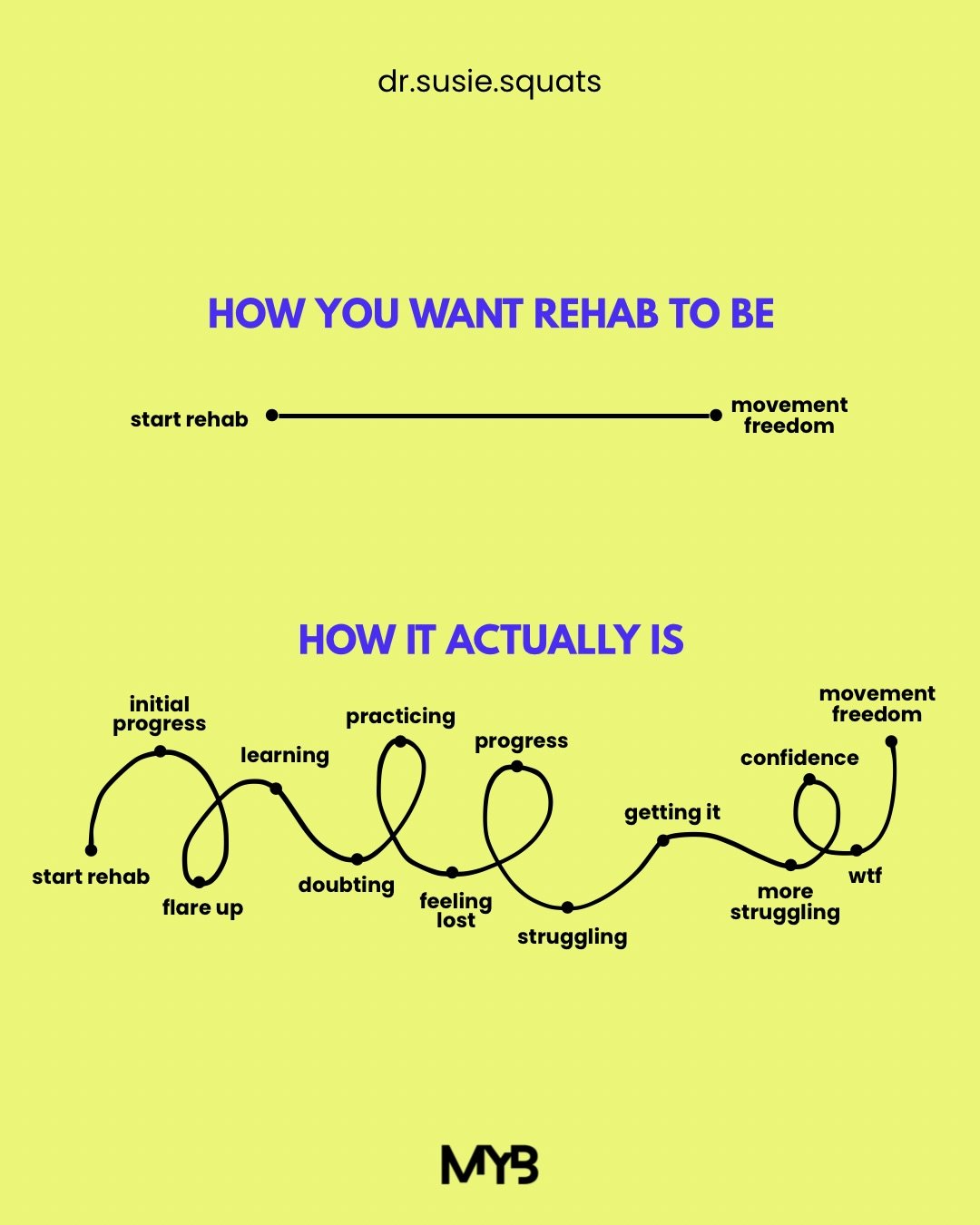
A major source of anxiety for people dealing with persistent pain is the fear of flare-ups. Many people have experienced situations where one bad training session triggered weeks of symptoms. Flare-ups are not unusual during rehabilitation. They are part of the process of gradually increasing tolerance and should be expected.
The difference is that within a structured program, flare-ups are expected and planned for.
Clients are given clear guidelines about acceptable symptom levels and recovery timelines. If symptoms spike, we adjust the training variables while maintaining some level of loading. This prevents the common cycle of pushing too hard, crashing, resting completely, and repeating the pattern.
Instead, we maintain forward momentum while refining the training dose.
Step Six: We Consider the Entire System
Training does not occur in isolation. Your body experiences all forms of stress, physical, emotional, and environmental, as load on the system. Sleep deprivation, emotional stress, illness, travel, and hormonal changes can all influence how your body tolerates physical training.
Research consistently shows that athletes with high life stress or poor sleep often demonstrate reduced tolerance to training loads. This means a program that looks perfect on paper can still fail if it ignores the context of someone’s life.
Your training plan must reflect your actual recovery capacity, not an idealized version of you who sleeps perfectly and experiences no external stress. When life becomes more demanding, training variables may need to adjust temporarily. When recovery improves, training loads can increase again.
This dynamic adjustment is essential for long-term progress.
Step Seven: We Adjust in Real Time
The human body is constantly adapting. What works this week may need refinement next week. Inside individualized rehab coaching, programming evolves based on new information.
Client feedback after sessions
Video analysis of movement patterns
Trends in symptom behavior
Changes in performance and fatigue
These inputs allow us to refine the training plan continuously. Rather than leaving someone to guess whether they should push harder or back off, the program responds to the signals their body provides.
The End Goal: Confidence and Capacity
When programming is done well, something powerful happens. People stop feeling fragile. They stop fearing the movements they once avoided. They stop wondering whether every workout will make things worse.
Instead, they build confidence in their body’s ability to adapt. And that confidence is built through repeated experiences of successful loading.
At the end of the day, rehab coaching is not about doing less. It’s about applying the right stress, at the right time, in the right dose, so your body can become stronger and more resilient.
Not just pain-free, but capable!
1-ON-1 PERSONALIZED FITNESS COACHING
Maximize your results and optimize your time in the gym with 1-1 guidance and personalized programming from an experienced coach and Doctor of Physical Therapy! Improve your strength gains, boost your recovery, and meet your goals. APPLY HERE to schedule a free consult with our team!
1-ON-1 REMOTE REHAB COACHING
Ready to get rid of frustrating pain, overcome injuries, and get back to doing what you love? Want to work with a Physical Therapist who keeps you active and understands your goals? APPLY HERE to schedule a free consult with our team!
SUPPLE STRENGTH ONLINE GROUP TRAINING
Want to build lean muscle mass, get strong, and feel confident in and out of the gym? In Supple Strength, you’ll access to FIVE different programs, both at-home and gym-based, all written by a Doctor of Physical Therapy (that’s me!). Join the last program you’ll ever need.
Follow me on instagram for more FREE content!